Why Aggressive Pomeranian Obedience Training Is More Common Than You Think
Aggressive Pomeranian obedience training is something thousands of dog owners struggle with every day — and most of them are surprised it’s even an issue with such a tiny dog.
Quick answer: How to manage an aggressive Pomeranian
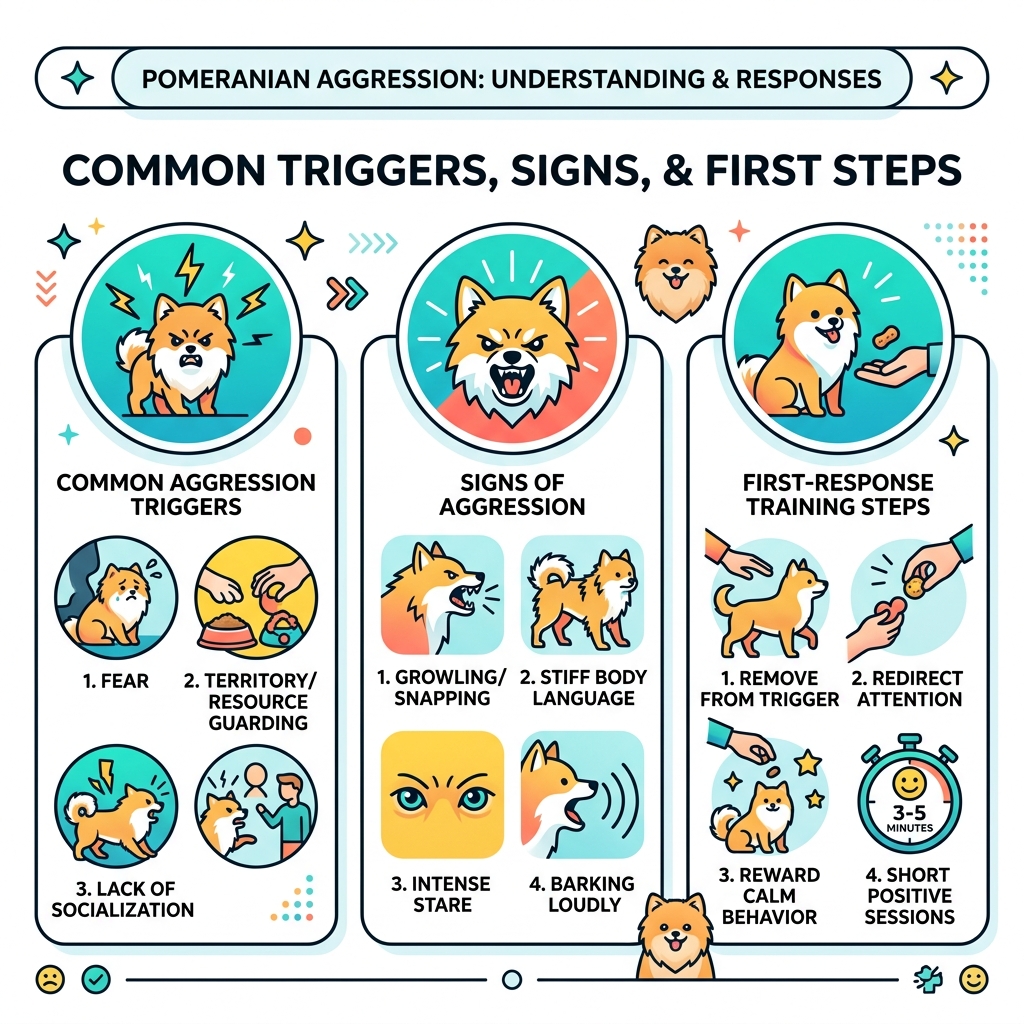
- Identify the trigger – fear, territory, pain, or lack of socialization
- Use positive reinforcement only – treats, praise, and play; never punishment
- Keep training sessions short – 3 to 5 minutes, several times daily
- Socialize consistently – controlled, calm exposure to people, dogs, and environments
- Teach impulse-control commands – sit, stay, quiet, and leave it
- Seek professional help – if aggression is severe or persistent, consult a trainer or vet
Pomeranians weigh between 3 and 7 pounds. But don’t let that fool you.
These dogs descend from large Arctic sled dogs — the Spitz family — and they haven’t forgotten it. That ancestry shows up as boldness, alertness, and a tendency to act like they own the room. When that confidence isn’t shaped through early training and socialization, it can tip into growling, snapping, barking, and reactive behavior toward other dogs or strangers.
It’s a phenomenon often called small dog syndrome — where owners excuse bad behavior because the dog is small and cute. The result? The Pomeranian never learns boundaries, and the behavior gets worse.
The good news: Pomeranians are highly intelligent and respond extremely well to the right training approach. This guide will walk you through exactly what that looks like.
Understanding the Roots of Aggressive Pomeranian Obedience Training
To effectively manage a “tiny terror,” we must first understand that a Pomeranian’s aggression is rarely about being “mean.” Instead, it is often a survival mechanism or a byproduct of their unique history. These dogs are essentially 100-pound sled dogs trapped in 5-pound bodies. When we look at aggressive pomeranian obedience training, we are usually dealing with a few specific root causes.
Fear-Based Reactivity and the Size Illusion
Because Pomeranians are so small, the world is a terrifying place. A Golden Retriever approaching to say hello looks like a woolly mammoth to a Pom. This leads to fear-based reactivity, where the dog lunges or barks to say, “Stay away from me!” before the “threat” gets too close. This “size illusion” causes them to overcompensate with bravado.
Territorial Instincts and Resource Guarding
Pomeranians were bred to be alert dogs. Their job was to bark at anything out of the ordinary. In a modern home, this translates to territorial aggression over the sofa, the front door, or even their favorite human. Resource guarding—growling when you try to take a toy or food—is also common. Understanding the big truth about small dog aggression and why it happens is the first step in realizing that your dog isn’t trying to be the boss; they are likely feeling insecure.
Lack of Puppy Socialization
Many owners skip socialization because they plan to carry their Pomeranian everywhere. However, if a puppy isn’t exposed to at least 100 different people and 50 different sounds during their critical window (2 to 6 months), they grow up viewing the unknown as a threat. This lack of exposure is a leading cause of adult aggression.
Core Strategies for Managing Aggressive Behaviors
When we begin aggressive pomeranian obedience training, our philosophy centers on benevolence and reward, not intimidation. Pomeranians are incredibly sensitive; if you yell at them or use physical punishment, they will either shut down or become more aggressive out of self-defense.
The Power of Positive Reinforcement
We use positive reinforcement because it builds a bond of trust. By leveraging positive reinforcement for training tiny canines, we teach the dog that “good things happen when I remain calm.”
- High-Value Treats: Forget standard kibble. For an aggressive Pom, you need the “big guns.” Freeze-dried liver, tiny bits of plain boiled chicken, or pea-sized pieces of cheese are ideal.
- Micro-Training Sessions: Pomeranians have the attention span of a goldfish with ADHD. We recommend sessions of just 3 to 5 minutes, spread 3 to 4 times throughout the day. This prevents frustration for both you and the dog.
- Consistency: If “no” means “no” today but “maybe” tomorrow because they look cute, the training will fail. Everyone in the household must use the same commands and rules.

Step-by-Step Guide to Basic Commands for Aggression Control
Obedience is the foundation of safety. A dog that is focused on a command cannot simultaneously be focused on lunging at a stranger. We focus on “impulse control”—teaching the dog to think before they react.
| Feature | Traditional Training | Micro-Training (Recommended) |
|---|---|---|
| Session Length | 20–30 Minutes | 3–5 Minutes |
| Frequency | Once daily | 3–5 times daily |
| Focus | Multiple commands | One specific skill |
| Success Rate | Moderate (dogs get bored) | High (keeps engagement) |
By mastering basic commands with your tiny pup, you create a “language” that allows you to redirect them during a flare-up.
Teaching ‘Sit’ and ‘Stay’ to Build Focus
- Lure: Hold a treat at their nose and slowly move it back over their head. Their bottom will naturally drop.
- Mark: The second their bottom touches the floor, say “Yes!” or click, and give the treat.
- Stay: Once they sit, hold your hand up like a stop sign. Wait one second, then reward. Gradually increase the time and the distance you step away.
- Goal: This builds “bottom-to-floor” contact as a default behavior when they are excited.
Using ‘Quiet’ and ‘Leave It’ in Aggressive Pomeranian Obedience Training
Barking is often the precursor to a physical aggressive act.
- Quiet: When your Pom barks, acknowledge it once (“Thank you, I see it”). Then, hold a treat to their nose. They can’t sniff and bark at the same time. When they stop, say “Quiet” and reward.
- Leave It: Place a low-value item on the floor. When they move toward it, cover it with your hand and say “Leave it.” When they look away from the item and at you, reward them with a high-value treat from your other hand. This teaches them to look to you for permission rather than reacting to triggers. How to effectively curb barking in small dogs involves identifying whether the bark is for an alarm, boredom, or anxiety.
Socialization and Desensitization Techniques
If your Pomeranian is already showing signs of aggression toward other dogs, you cannot simply throw them into a dog park. That is a recipe for disaster. Instead, we use desensitization and counter-conditioning.
Counter-Conditioning and Parallel Walking
The goal is to change the dog’s emotional response to a trigger. If your dog hates other dogs, we want them to think: Other dog = Liver treats.
- Safe Threshold: Find the distance where your dog sees another dog but hasn’t started barking yet (the “threshold”).
- The Look: Every time they look at the other dog, give them a treat.
- Parallel Walking: Walk with a friend and their calm dog on the opposite side of the street. Don’t let them meet. Just walk in the same direction. This allows your Pom to “exist” near another dog without the pressure of a face-to-face greeting.
For more on this transition, see our guide from tiny terror to good boy: training tips for aggressive small dogs.
Reducing Reactivity During Aggressive Pomeranian Obedience Training
- ‘Watch Me’ Command: This is vital. Hold a treat to your nose and say “Watch me.” When the dog makes eye contact, reward. Use this when you see a trigger approaching to keep their focus on you.
- Muzzle Training: Don’t be afraid of the muzzle. A basket muzzle allows the dog to pant, drink, and take treats while ensuring everyone stays safe during training. It is a responsible tool, not a punishment.
Advanced Management: Crate Training and Professional Help
Sometimes, aggression is more than just a behavioral quirk; it can be a sign of a deeper issue.
Crate Training as a Safe Haven
A crate should never be a “jail.” It is your dog’s bedroom. For an aggressive dog, the crate provides a safe space where they don’t feel the need to “guard” the whole house. It also assists with housebreaking. Pomeranians have walnut-sized bladders and need to go out every 1-2 hours. Accidents in the house lead to frustration, which can increase irritability and aggression.
Veterinary Health Checks
Before assuming your dog is just “stubborn,” see a vet. Pomeranians are prone to:
- Tracheal Collapse: This causes coughing and physical discomfort, making a dog very cranky.
- Luxating Patella: Knee pain can cause a dog to snap when touched.
- Alopecia X or Skin Issues: Irritated skin makes for an irritable dog.
If your dog’s aggression is sudden, it is likely medical. If it is persistent and dangerous, managing and correcting aggressive behavior in small dogs may require a certified veterinary behaviorist. We are here to help you navigate addressing small dog behavior issues with professional, compassionate strategies.
Frequently Asked Questions about Pomeranian Aggression
Why is my Pomeranian aggressive toward larger dogs?
This is usually “Napoleon Complex” driven by fear. Because they feel vulnerable due to their size, they use offensive posturing (barking, lunging) to keep the larger dog away. It’s a “hit them before they hit me” mentality. Early, controlled socialization with calm, larger “mentor” dogs can fix this.
Can an older Pomeranian be retrained?
Absolutely. While puppies are like sponges, older dogs possess neuroplasticity. It may take longer to break established habits, but with consistent aggressive pomeranian obedience training and high-value rewards, even a senior Pom can learn new prosocial behaviors.
How do I stop my Pomeranian from snapping at strangers?
Implement a “no-touch” rule for strangers. Don’t let people reach over the dog’s head to pet them, as this is threatening. Instead, have the stranger toss a treat near the dog without making eye contact. This teaches the dog that strangers are “treat dispensers” rather than threats.
Conclusion
Living with an aggressive Pomeranian can be exhausting, but remember: your tiny friend is likely just a big personality trying to navigate a world that feels too large. Through patience, persistence, and benevolent leadership, you can transform that “miniature hurricane” into a well-mannered companion.
At Portal Tambas, we specialize in these exact issues. By focusing on positive reinforcement and understanding the unique Spitz temperament, you can reclaim the peace in your home. For more specialized advice, check out our expert training tips for small dogs. Your Pomeranian wants to be a “good boy” or “good girl”—they just need you to show them the way.