When Your Tiny Dog Has a Big Attitude: What You Need to Know About Aggression in Italian Greyhounds Training
Aggression in Italian greyhounds training is more common than most owners expect — and almost always misunderstood. These elegant little dogs look fragile, but they can snap, lunge, nip, and guard with surprising intensity.
Here’s a quick overview of what’s driving it and what you can do:
| Type of Aggression | Common Trigger | First Step |
|---|---|---|
| Fear-based nipping | Strangers, sudden movement | Passive training, soft introductions |
| Resource guarding | Food, toys, furniture | “Leave it” / “Drop it” commands |
| Leash reactivity | Other dogs, owner tension | NILIF program, desensitization |
| Pain-induced aggression | Dental disease, joint pain | Vet check before any training |
| Redirected aggression | Barrier frustration | Environmental management |
Italian Greyhounds — often called Velcro dogs — form deep bonds with their people. That same sensitivity that makes them so loving also makes them highly reactive to stress, fear, and inconsistency. When they feel cornered or overwhelmed, aggression is often their only way out.
One telling example: a fearful Italian Greyhound mix named Penny Lane, kept in a covered kennel during a training session, emerged after just 15 minutes once a calm, patient approach was used — taking treats, sniffing the trainer, and allowing handling. The dog didn’t need force. She needed safety.
That’s the core of the issue. Most aggression in Italian Greyhounds isn’t about dominance or “bad” dogs. It’s about fear, confusion, and unmet needs — and it responds well to the right approach.
Understanding the Roots of Aggression in Italian Greyhounds Training
To effectively manage aggression in Italian greyhounds training, we must first look at the unique DNA of this ancient breed. Known as “pint-sized sighthounds,” Italian Greyhounds (or “Iggies”) were bred for centuries as noble companions, a history documented by the American Kennel Club. This history has left them with a dual nature: they possess the lightning-fast prey drive of a hunter and the extreme emotional sensitivity of a lapdog.
Research into the breed temperament reveals that they are quintessential “Velcro dogs.” They attach to their owners, often favoring one specific family member. While this creates a beautiful bond, it can also lead to separation anxiety and territorial behavior. When an Iggy feels their “person” is threatened or when their routine is disrupted, that anxiety can quickly manifest as reactive barking or snapping.
Furthermore, socialization gaps are a primary culprit. Because they are small and delicate, owners often overprotect them, inadvertently preventing them from learning how to navigate the world confidently. Without early and varied exposure to different people, sounds, and environments, an Italian Greyhound may view anything “new” as a threat. This is where Training Tips become essential; building confidence through mental stimulation and structured play can prevent the fearful “fight” response from ever triggering.
Identifying Fear-Based Aggression in Italian Greyhounds Training
Most aggressive displays in this breed are actually defensive. Unlike larger breeds that might guard a territory out of a sense of duty, an Iggy usually nips because they feel they have no other choice. This is often seen when “Helping a Fearful Italian Greyhound Mix” who has spent too much time in kennel isolation or a high-stress shelter environment.
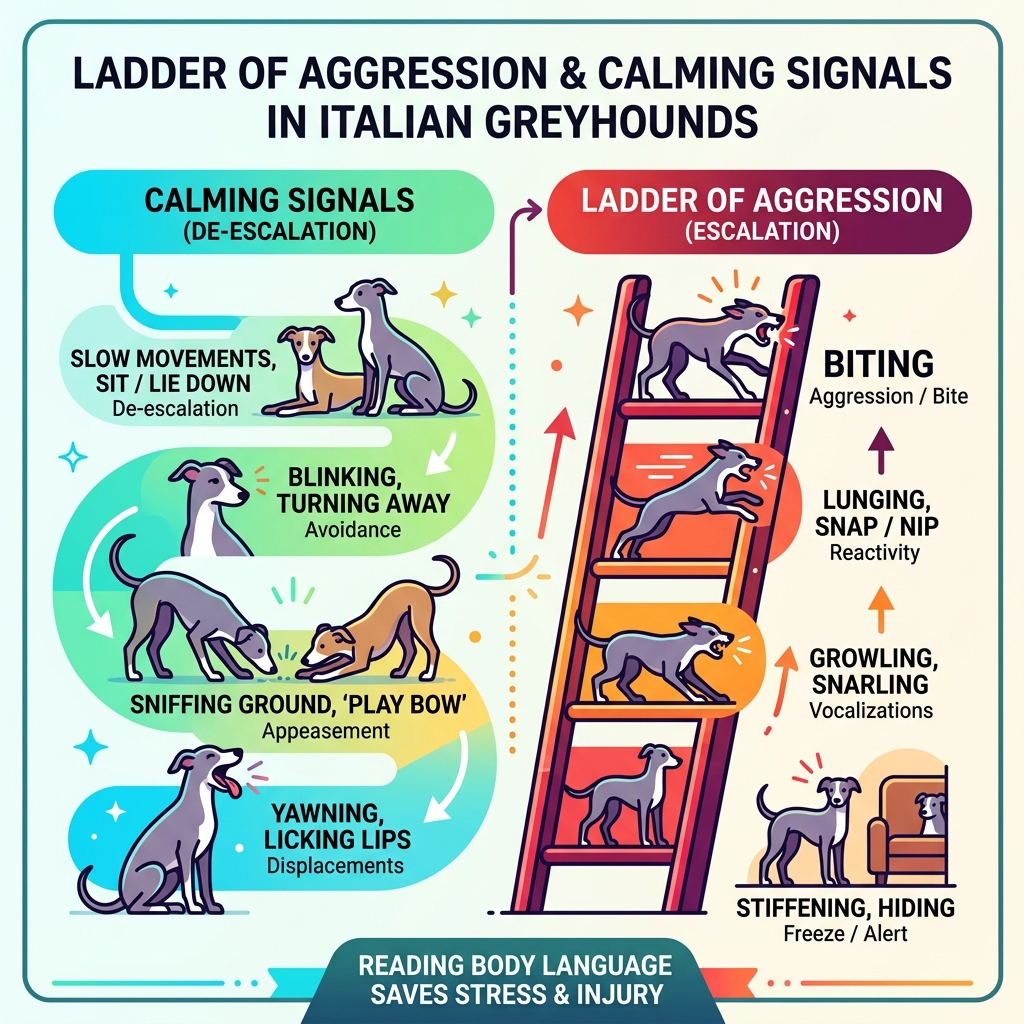
The “flight response” is an Iggy’s first instinct. However, when they are leashed, cornered on a couch, or held in someone’s arms, they cannot flee. This leads to defensive biting. You might notice your dog stiffening, showing the whites of their eyes (whale eye), or licking their lips before a snap occurs.
We recommend “passive training” for these fearful pups. This involves rewarding the dog for behaviors they offer on their own. If a fearful Iggy chooses to step out of their crate or sniff a guest’s hand, they receive a high-value treat. This teaches them that interacting with the world is safe and rewarding, rather than something to be feared.
The Role of Sensitivity in Behavioral Escalation
Italian Greyhounds are perhaps the most “soft” breed in the canine world. They are incredibly sensitive to human emotions and tone of voice. This means that harsh corrections—like yelling, “alpha rolls,” or physical discipline—are not just ineffective; they are catastrophic.
When an owner uses punishment, it erodes the trust that is the foundation of the Iggy-human relationship. A dog that is hit or shouted at will learn that their owner is unpredictable and scary. This often results in a dog that bites “out of nowhere” because they have been punished for growling (their natural warning signal) and now go straight to the snap to protect themselves.
When “Correcting an Italian Greyhound,” we must use soft body language and positive reinforcement. If they do something wrong, a firm, low-pitched “No” is usually more than enough. The goal is to guide them toward the right choice, not to scare them into submission.
Common Triggers: From Resource Guarding to Leash Reactivity
Understanding triggers is the secret to successful aggression in Italian greyhounds training. Two of the most common issues we see are resource guarding and leash reactivity.
Resource guarding often starts small—a growl over a favorite toy or a snap when you try to move them off the “good” pillow. Because Iggies love comfort, they can become very possessive of furniture. In multi-dog households, this can escalate into “latching” onto another dog’s neck over a dropped treat or a specific bed.
Leash reactivity is a different beast. Many owners report that their Iggy is an angel at the dog park but a “land shark” on the leash. This is often due to “barrier frustration” or “owner tension.” When you see another dog and tighten the leash, you are sending a signal down the line that says, “I’m nervous, you should be too!” The dog then barks and lunges to keep the “threat” away.
| Behavior | Leash Reactivity | Off-Leash Social Behavior |
|---|---|---|
| Body Language | Tense, lunging, high-pitched barking | Bouncy, sniffing, “zoomies” |
| Motivation | Fear of being trapped, protecting owner | Desire to play or investigate |
| Response to Dogs | Snarling, snapping at 50+ feet | Generally friendly or indifferent |
| Owner Influence | High (leash tension, vocal anxiety) | Low (dog acts independently) |
Effective Methods for Correcting Aggression in Italian Greyhounds Training
To fix these issues, we implement structured protocols that prioritize the dog’s mental state.
- NILIF (Nothing In Life Is Free) Program: This is the gold standard for bossy or guarding dogs. The dog must “earn” everything—meals, walks, and even petting—by performing a simple command like “sit” or “touch.” This establishes you as a calm leader without using force.
- “Leave it” and “Drop it” Commands: These are life-saving skills. Start with low-value items and trade up for high-value treats (like slivers of hot dog or roast chicken). Never just “yank” something out of an Iggy’s mouth; this creates a “guarding” trauma. Instead, always offer a better trade.
- Desensitization and Counter-Conditioning: If your dog is aggressive toward strangers, start by having a friend stand at a distance where the dog is calm. Feed the dog treats as long as the stranger is in sight. Slowly decrease the distance over several sessions. You are literally rewiring the dog’s brain to associate “strangers” with “steak.”
- Reward-Based Timing: In aggression in Italian greyhounds training, timing is everything. You must reward the absence of the bad behavior. If your dog looks at another dog and doesn’t bark for one second, click and treat immediately.
Medical vs. Behavioral: When to Rule Out Pain
Before you hire a trainer, you must visit a vet. Because Italian Greyhounds are so stoic and delicate, they often hide pain until it becomes unbearable, leading to sudden “unexplained” aggression.
We frequently see Iggies snapping because of:
- Dental Disease: Periodontal pain is rampant in this breed. A dog with a throbbing tooth will snap if you try to kiss their face or touch their muzzle.
- Patellar Luxation: If their kneecap is slipping, they may become aggressive when you try to pick them up or move them off the couch.
- Thyroid Issues: Hypothyroidism can cause sudden irritability and “rage” symptoms in otherwise sweet dogs.
- Growth Plate Injuries: In puppies, high-impact exercise can cause micro-fractures that make the legs tender to the touch.
Check out our Health Care section for more on breed-specific ailments. If your dog’s aggression is sudden or happens primarily when touched, it is likely a medical issue, not a behavioral one.
Immediate Safety Measures and Professional Intervention
If your Italian Greyhound has already bitten or is showing severe lunging behavior, safety is the priority.
- Basket Muzzles: Don’t be afraid of the muzzle! A properly fitted basket muzzle allows the dog to pant, drink, and take treats while preventing a bite. More importantly, it allows you to relax. If you aren’t worried about a bite, you won’t be tense, which helps the dog stay calm.
- Furniture Restrictions: If your dog guards the couch, they lose couch privileges. Provide a comfortable, heated dog bed on the floor. This removes the “high ground” that often contributes to a dominance mindset.
- Environmental Management: Use baby gates to separate dogs during meal times and keep high-value toys put away when guests are over.
- Professional Help: While a general trainer is great for “sit” and “stay,” aggression in Italian greyhounds training often requires a Certified Applied Animal Behaviorist (CAAB) or a Veterinary Behaviorist. These experts understand the neurobiology of fear and can help with complex cases involving multi-dog aggression or severe phobias.
Frequently Asked Questions about Italian Greyhound Aggression
Why is my Italian Greyhound suddenly snapping at me?
Sudden snapping is almost always a sign of pain or a recent traumatic event. Check for dental issues or joint pain first. If medical issues are ruled out, look for “trigger stacking”—has the dog been stressed by a move, a new baby, or a loud storm recently? Sometimes the “snap” is just the final straw.
Can leash aggression be cured in older Iggies?
“Cured” is a strong word, but it can absolutely be managed and significantly improved! Thanks to neuroplasticity, older dogs can learn new emotional responses. It takes patience and consistent desensitization, but even a 10-year-old Iggy can learn to walk calmly past a neighbor’s dog.
Is it safe to use a shock collar for aggression?
Absolutely not. For a sensitive breed like the Italian Greyhound, a shock collar is a recipe for disaster. It will likely increase their fear and could lead to “redirected aggression,” where the dog bites the nearest person or animal because they are in sudden, sharp pain. Stick to force-free, reward-based methods.
Conclusion
At Portal Tambas, we believe that every “aggressive” small dog is usually just a misunderstood one. Managing aggression in Italian greyhounds training requires a shift in perspective—from seeing a “bad dog” to seeing a “scared dog.”
By combining consistent leadership (NILIF), positive reinforcement, and a deep understanding of their physical health, you can restore the peace in your home. Trust takes months to build but only seconds to break. Be patient, stay calm, and always advocate for your dog’s safety and comfort.
If you are struggling with a severe case where the safety of children or other pets is at risk, don’t hesitate to reach out to a professional behaviorist. In some rare cases, rehoming to a single-pet, quiet household may be the kindest decision for a dog that simply cannot cope with a high-activity environment.
For more specialized guides on small dog behavior, visit our Training Tips page. Let’s work together to bring out the sweet side of your Italian Greyhound!