Identifying the Root Causes of Small Dog Reactivity
To calm aggressive small dog at home, we must first act as detectives. Aggression is rarely a random “personality flaw.” Instead, it is a functional behavior—the dog is trying to achieve a specific result, such as making a scary person go away or protecting a prized toy.
Understanding the motivation is the first step toward a solution. According to ASPCA research on aggression, most canine aggression can be classified into specific categories.
- Fear-Based Aggression: This is the most common cause in small breeds. Because the world is giant-sized to a five-pound Yorkie, they often feel vulnerable. If they feel trapped or cornered, they may “get the first punch in” to protect themselves.
- Conflict-Induced (formerly Dominance) Aggression: This occurs when a dog is uncertain about social rules or is trying to control access to resources. We often see this when an owner tries to move a dog off a sofa or take away a bone.
- Pain-Induced Aggression: A sudden change in temperament is a massive red flag. Small dogs are prone to dental issues, luxating patellas (knee caps that pop out), and neck pain. If it hurts to be touched, they will snap to keep you away.
- Territorial and Protective Aggression: Often emerging between one and three years of age, this is directed at “intruders” like the mail carrier or guests.
We dive deeper into these motivations in our guide on the big truth about small dog aggression.
Medical Triggers: Why a Vet Visit is Step One
Before you hire a trainer, you must visit a veterinarian. Small dogs are notorious for “silent” pain. A Yorkie with a rotting tooth or a Chihuahua with an ear infection will be understandably “aggressive” when you try to pet their head.
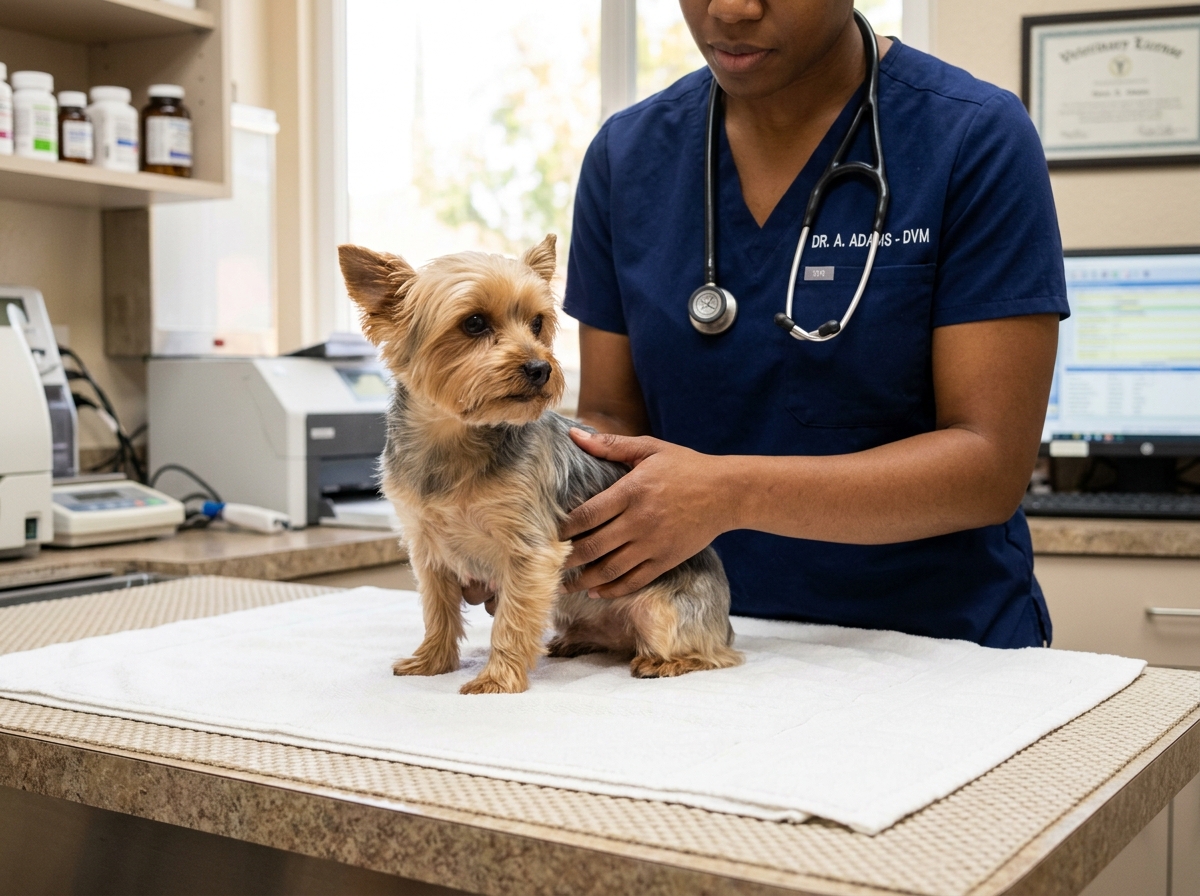
If your dog is suddenly snapping when touched in specific areas, medical intervention—not training—is the cure. Once the pain is managed, the “aggression” often vanishes.
Subtle Body Language Cues of a Calm Aggressive Small Dog at Home
Many owners are shocked when their dog bites because the dog seemed “calm” just seconds before. However, dogs almost always give warnings; we just aren’t always great at reading them. Addressing small dog behavior issues requires us to notice the “whispers” before the “shouts.”
Watch for these subtle signs of discomfort:
- Lip Licking and Yawning: When not related to food or sleep, these are “displacement behaviors” indicating stress.
- Whale Eye: You can see the whites of the dog’s eyes as they watch a “threat” without moving their head.
- Body Stiffening: The dog becomes a “statue.” This is the final warning before a snap.
- Tail Position: A wagging tail does not always mean happy. A stiff, high, fast-vibrating tail is a sign of high arousal and potential aggression.
- Ear Pinning and Lowered Head: These indicate a fearful dog who is feeling defensive.
Proven Strategies to Calm Aggressive Small Dog at Home
Once medical issues are ruled out, we focus on management and modification. You cannot “fix” aggression if the dog is constantly being triggered. Management means preventing the dog from practicing the bad behavior.
Management and Safety
Use safety barriers like baby gates or crates to give your dog a “safe zone” where they won’t be bothered by guests or children. If your dog is aggressive at the door, a visual barrier (like frosted window film) can prevent them from seeing triggers outside.
We recommend a structured approach to managing and correcting aggressive behavior that focuses on safety first.
Fear vs. Conflict: Knowing the Difference
| Sign | Fear-Based Aggression | Conflict-Induced Aggression |
|---|---|---|
| Trigger | Strangers, loud noises, being cornered | Being moved, having toys taken, grooming |
| Body Language | Cowering, ears back, tail tucked | Standing tall, leaning forward, stiff tail |
| Reaction | Snaps and retreats | Snaps and stands ground |
| Owner Action | Build confidence and provide space | Establish clear rules and “Learn to Earn” |
Building Trust with a Calm Aggressive Small Dog at Home
If your dog does not want to be touched, stop trying to touch them. Forcing affection on a fearful dog is a recipe for a bite. Instead, we want the dog to realize that our presence predicts wonderful things.
- Get on Their Level: Sit on the floor at a distance. Don’t look directly at them (staring is a threat in dog language).
- The “Treat Fairy” Method: Toss high-value treats (chicken, cheese) near the dog without making them come to you. Let them choose to approach.
- Avoid Hovering: Reaching over a small dog’s head is terrifying for them. Always reach for the chin or chest once they are comfortable.
- Hand Targeting: Teach the “touch” command where the dog boops your palm with their nose. This gives them a way to interact with your hand that is safe and rewarded.
Leveraging positive reinforcement for tiny canines is the fastest way to turn a “terror” into a trusting companion.
Effective Training Techniques for Apartment Living
Living in an apartment with an aggressive small dog adds a layer of stress—neighbors, hallways, and thin walls make barking a major issue. To calm aggressive small dog at home in a high-density environment, we use desensitization and counter-conditioning.
Desensitization and Counter-Conditioning
This involves exposing your dog to a trigger (like the sound of the elevator) at a very low volume/intensity and pairing it with a reward.
- Step 1: Play a recording of a doorbell at a volume so low your dog doesn’t bark.
- Step 2: Give a treat.
- Step 3: Gradually increase the volume over several days. Eventually, the doorbell becomes a “dinner bell” rather than a call to arms. This is a core part of how to effectively curb barking in small dogs.

The “Small Dog Syndrome” Trap
Small Dog Syndrome isn’t a medical condition; it’s a result of us treating small dogs differently than large ones. If a Great Dane lunged at a stranger, we would seek immediate help. If a Yorkie does it, we might find it “cute” or just pick them up.
To stop this, treat your small dog like a big dog. Set boundaries, expect them to walk on a leash, and don’t allow them to “boss” the household.
Managing Barking and Reactivity
- White Noise: Use a fan or white noise machine to drown out hallway sounds.
- Window Film: If your dog barks at people through the window, frosted film allows light in but blocks the visual trigger.
- The “Quiet” Command: Use a clicker to mark the exact second your dog stops barking, then reward.
- Mental Stimulation: A tired dog is a quiet dog. Use puzzle toys and scent work to burn off “anxious energy.”
Consistent training, like mastering basic commands with your tiny pup and proper leash training, provides the structure small dogs crave to feel secure.
Professional Intervention vs. Rehoming: Making the Hard Choice
Sometimes, despite our best efforts, the situation feels unmanageable. Before you consider surrendering your dog, ask yourself: Have I consulted a professional?
A certified applied animal behaviorist (CAAB) or a veterinary behaviorist (Dip ACVB) can create a tailored plan. They can also assess if medication (like fluoxetine or trazodone) might be necessary to “lower the volume” on your dog’s anxiety so they can actually learn.

We offer many tips for training aggressive small dogs, but a professional can provide the hands-on guidance many owners need.
When is rehoming the right choice?
- If there are children in the home who are at risk.
- If the dog’s quality of life is poor due to constant, unmanageable fear.
- If the owner is physically or emotionally unable to maintain the necessary safety protocols.
However, surrendering an aggressive dog often leads to euthanasia in many shelters. Committing to a management plan is usually the kindest path.
Frequently Asked Questions about Small Dog Aggression
Can small dog aggression be completely cured?
In many cases, the frequency of aggression can be reduced to near zero. However, most experts prefer the term “managed” over “cured.” You should always be aware of your dog’s triggers. If your dog is aggressive toward children, you should never assume they are “cured” and leave them unsupervised, even after years of good behavior.
Why does my small dog bite when I try to pet him?
This is usually “touch aversion.” It can be caused by past negative experiences (like a child grabbing them), pain, or simply a lack of socialization. Respect their space. If they walk away when you reach for them, let them go. Forcing the interaction only teaches them that biting is the only way to get you to stop.
Is it ever too late to train an aggressive Yorkie puppy?
Never! While the “prime” socialization window is between 4 and 12 weeks, dogs possess neuroplasticity throughout their lives. Senior dogs can learn new behaviors and unlearn old ones. The key is consistent leadership and patience.
Conclusion
At Portal Tambas, we believe that every “tiny terror” has the potential to become a “good boy.” To calm aggressive small dog at home, you don’t need to be a “pack leader” who uses force or intimidation. You need to be a calm, consistent guide who provides safety and clear boundaries.
Patience is your greatest tool. Changing an emotional response takes time—often months, not days. But when your Yorkie finally chooses to curl up next to you on the sofa instead of growling at your hand, you’ll know every second of training was worth it.
For more expert advice on small dog behavior, explore our library of resources dedicated to the unique needs of tiny canines.