The Truth Behind Myths About Aggressive Small Breeds
Myths about aggressive small breeds are everywhere — and they’re causing real problems for dog owners who just want help.
Here’s a quick look at the most common myths and what’s actually true:
| Myth | Reality |
|---|---|
| Small dogs are naturally meaner than large dogs | Aggression is driven by fear, lack of training, and owner behavior — not size |
| Chihuahuas and Dachshunds are just “ankle biters” | These breeds often act defensively due to vulnerability and poor socialization |
| Small dog aggression isn’t a real problem | Nearly 49% of U.S. small animal veterinarians rate Chihuahuas as a high serious bite risk |
| You can’t train aggression out of small dogs | Consistent positive reinforcement can significantly reduce aggressive behavior |
| It’s cute when small dogs act tough | Tolerating bad behavior actually makes it worse over time |
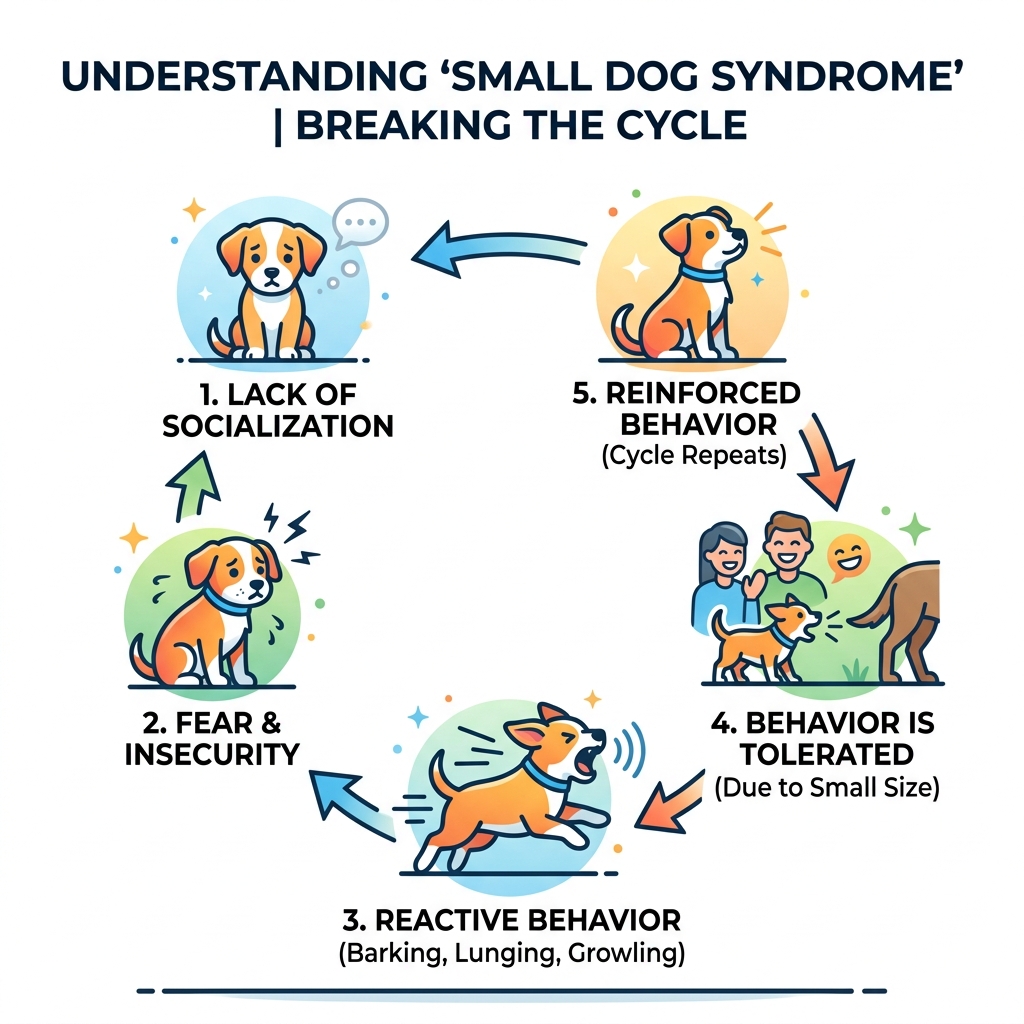
Picture this: a tiny Chihuahua at a coffee shop, barking and lunging at a passing Labrador. Bystanders laugh. The owner shrugs. Nobody intervenes. Now imagine a German Shepherd doing the same thing. Very different reaction, right?
That double standard is exactly what fuels the problem.
Small dogs get labeled “ankle biters,” accused of having a “Napoleon complex,” or dismissed as “tiny terrors.” These labels might seem harmless, but they actually make things worse. When owners don’t take small dog behavior seriously, training gets skipped, boundaries don’t get set, and fear-based reactions escalate into real aggression.
The truth is more nuanced — and more hopeful — than the stereotypes suggest.
Debunking the Top Myths About Aggressive Small Breeds

When we talk about myths about aggressive small breeds, we have to look at the “why” before the “what.” In dog behavior, size often dictates how we perceive a dog’s intent. If a Great Dane growls, we call a trainer. If a Yorkie growls, we might take a video for social media. This disparity is at the heart of why small dogs have such a feisty reputation.
Scientific research, such as the studies detailed in Fact or Fiction: Why Are Small Dogs So Aggressive?, suggests that breed is often a poor predictor of individual behavior. Instead, environmental factors and owner interactions play a massive role. At Portal Tambas, we often see that addressing-small-dog-behavior-issues requires looking at the human end of the leash just as much as the dog’s.
One major factor is the “bite risk perception.” Because a small dog’s bite usually causes less physical damage than a large dog’s, owners are often more lenient. This leniency leads to significant socialization deficits. When a puppy isn’t taught how to interact with the world because “they’re too small to get hurt” or “they’re too small to hurt anyone,” they grow up lacking the social tools to handle stress.
Myth 1: Small Breeds Are Naturally Meaner Than Large Dogs
Is it in their DNA to be “mean”? Not exactly. A massive study by the University of Helsinki involving over 9,000 dogs found that small dogs do indeed have higher odds of aggressive behavior. However, the reasons aren’t rooted in “meanness.”
Instead, it comes down to fear-based reactivity and vulnerability. Think about life from a six-pound perspective. Every human is a giant, every car is a monster, and even a friendly Golden Retriever is a potential steamroller. Small dogs are much more likely to go on the defense because they feel physically threatened.
There is also a genetic component to consider. Research published in 2016 (BMC Genomics) found a link between a growth factor gene (IGF1) that gives dogs their small stature and certain behavioral traits, including increased anxiety and aggression. But genetics is not destiny; it’s simply a baseline that training can help manage.
Myth 2: Tiny Dogs Don’t Need Formal Training
This is perhaps the most damaging of all myths about aggressive small breeds. We call it the “cuteness bias.” When a tiny puppy barks, it’s adorable. When they nip at heels, it’s a game. This lack of boundaries tells the dog that aggressive displays are acceptable—or even rewarded with attention.
Without formal training, small dogs fail to develop essential social skills. They don’t learn how to “settle” or how to look to their owner for guidance when they’re scared. We’ve found that learning how-to-effectively-curb-barking-in-small-dogs is one of the first steps in establishing a common language between owner and pet. Consistency is key. If you wouldn’t let a 100-pound dog jump on your guests, don’t let your 10-pound dog do it either.
The Science Behind the “Feisty” Reputation
Why do we think small dogs are so much more aggressive than they actually are? Science gives us some fascinating insights into the gap between perception and reality.
The 2021 Helsinki study mentioned earlier confirmed that fear is the primary driver of aggression in smaller dogs. Highly fearful dogs were found to be five times more likely to exhibit aggressive behavior than their confident counterparts. This isn’t a “Napoleon Complex” (a desire to dominate); it’s a survival mechanism.
Furthermore, research published in Why Small Dogs Behave Differently Than Large Dogs points to “owner consistency” as a major variable. Small dog owners are statistically less likely to engage in formal training or shared activities like agility or obedience. This lack of engagement leads to higher cortisol levels (stress hormones) in small dogs, making them more reactive to environmental triggers like doorbells or strangers.
Why Fear is Often Mistaken for Aggression
When a dog lunges or snaps, we see “aggression.” But a dog’s brain might be screaming “fear.” Because small dogs are so vulnerable, they often skip the subtle warning signs and go straight to defensive biting.
As owners, we need to learn to read the “silent” stress signals before the bark happens:
- Whale Eye: When the white part of the eye shows as they look away.
- Lip Licking: A common sign of anxiety.
- Tight Face: Stiffening of the muzzle or forehead.
- Hunched Posture: Trying to appear smaller or ready to bolt.
By recognizing these signs, we can intervene before the dog feels the need to “fight” because “flight” isn’t an option (especially if they are on a leash or being held).
Which Breeds Face the Most Unfair Stereotypes?
Certain breeds have become the “poster children” for small dog aggression. Chihuahuas, Dachshunds, and Jack Russell Terriers are frequently labeled as the most aggressive, but the data tells a more complicated story.
According to a survey of U.S. small animal veterinarians, Chihuahuas were perceived as a high serious bite risk by 48.5% of respondents. Dachshunds (17.8%) and Jack Russell Terriers (15.7%) followed. Interestingly, these same veterinarians rated their emotional response to an off-leash Chihuahua as a 4.58 out of 10 (where 0 is petrified), which is nearly identical to their fear of an approaching Pit Bull (4.31).
The media also plays a role. Viral videos of “angry” Chihuahuas often treat the dog’s genuine distress as a comedy bit. This reinforces the Don’t Fall for These 5 Small Dog Breed Myths that these dogs are just “naturally like that.”
The Truth About Myths About Aggressive Small Breeds Like Chihuahuas
The Chihuahua is perhaps the most misunderstood dog in the world. While they do have high bite frequency stats in some studies, the severity of those bites is rarely life-threatening. The “land shark” label usually comes from their intense loyalty to one person and their extreme wariness of strangers—both traits that can be managed with early socialization.
Veterinary data shows that 26.6% of vets consider Chihuahuas inappropriate for families with children under 18. This isn’t necessarily because the dog is “evil,” but because Chihuahuas are fragile. A toddler’s clumsy hug can cause physical pain, leading the dog to bite in self-defense.
Understanding the Myths About Aggressive Small Breeds in Terriers
Jack Russell Terriers and Miniature Schnauzers are often called “aggressive” when they are actually just “intense.” Jack Russells were bred for hunting—they have a massive prey drive and incredible tenacity. When a JRT lunges at a squirrel or another dog, it’s often their working dog roots coming to the surface, not a desire to be “mean.”
Miniature Schnauzers, similarly, were bred as watchdogs. Their tendency to bark at strangers is a feature, not a bug. Misinterpreting this intensity as aggression leads to frustration for both the owner and the dog.
How to Prevent Aggression and Build Confidence
The good news is that myths about aggressive small breeds don’t have to be your dog’s reality. Prevention starts with building confidence. A confident dog doesn’t feel the need to bite.
We highly recommend starting early socialization during the critical window of 3 to 14 weeks. This doesn’t mean just “meeting people”—it means positive, controlled exposure to different sounds, surfaces, and environments. If you’ve missed that window, don’t worry. Desensitization can happen at any age; it just takes more patience.
At Portal Tambas, we emphasize managing-and-correcting-aggressive-behavior-in-small-dogs through positive reinforcement. Rewarding calm behavior around triggers is far more effective than punishing a growl. In fact, punishing a growl is dangerous—it teaches the dog to skip the warning and go straight to the bite.
Respecting Boundaries and Agency
One of the biggest reasons small dogs become aggressive is that we constantly violate their personal space. Because they are portable, we “scoop” them up without warning. Imagine if a giant reached down and grabbed you every time you were trying to have a conversation!
- Practice Consent: Instead of picking them up, sit on the floor and invite them into your lap.
- Cooperative Care: Use treats to make grooming and vet visits a choice rather than a struggle.
- Mental Enrichment: Small dogs have big brains. Puzzle toys, nose work, and trick training can burn off the nervous energy that often leads to reactivity.
- Exercise Requirements: Don’t assume a lap dog doesn’t need to run. Most small breeds need at least 20 minutes of heart-thumping exercise three times a week to stay mentally balanced.
Frequently Asked Questions about Small Dog Temperament
Are Chihuahuas more aggressive than Pit Bulls?
This is a complex question. In terms of perceived bite risk, many veterinarians rate Chihuahuas as a higher risk for frequent biting. However, Pit Bulls often face more intense media scrutiny. According to the American Temperament Test Society (ATTS), many “bully breeds” actually score higher for stability and friendliness than some popular small breeds. The difference is usually in the context—small dogs bite out of fear/vulnerability, while larger breed issues may stem from different environmental factors.
Can you train aggression out of a small dog?
You can certainly manage and significantly reduce it! While “curing” is a strong word, behavior modification through positive reinforcement can teach a dog new ways to cope with their triggers. Consistency is the most important factor. If everyone in the house follows the same rules and rewards the same calm behaviors, even the most “feisty” dog can learn to relax.
Why does my small dog bark at every stranger?
It’s usually a combination of stranger uncertainty and territoriality. Small dogs often feel they need to “big themselves up” to keep potential threats away. If they bark and the stranger walks away (which they usually do), the dog thinks, “Hooray! It worked!” This reinforces the behavior. Proper socialization and teaching a “quiet” command are essential here.
Conclusion
At Portal Tambas, we believe that every dog deserves to be understood as an individual, regardless of their size. The myths about aggressive small breeds only serve to isolate owners and leave dogs in a state of constant anxiety. By moving away from labels like “ankle biter” and toward responsible ownership and specialized training, we can end breed discrimination and help our tiny companions live their best lives.
Responsible ownership means advocating for your dog’s space, providing the exercise they crave, and never settling for “it’s just how they are.” With the right tools and a little bit of patience, your “land shark” can become the confident, calm companion you’ve always wanted.
For more hands-on advice, check out our latest Training Tips to start your journey today.