The Best Leash for Puppy Training Makes All the Difference
The best leash for puppy training is a 4-6 foot nylon or leather flat leash — long enough to give your pup a little room, short enough to keep you in control.
Here’s a quick look at the top picks:
| Leash Type | Best For | Recommended Length |
|---|---|---|
| Standard flat nylon | Everyday training, loose-leash walking | 4-6 feet |
| Braided leather | Durability, comfort, strong pullers | 4-6 feet |
| Long-line lead | Recall training, distance stays | 15-30 feet |
| Slip lead | Quick control, professional training | 4-6 feet |
| Hands-free leash | Active owners, hiking, running | Varies |
A leash is one of the most basic pieces of gear you’ll ever buy for your dog. But pick the wrong one, and every walk turns into a tug-of-war.
If you have a small dog — especially one who’s already showing signs of frustration or pushiness on the leash — the stakes are even higher. The wrong leash reinforces bad habits. The right one gives you a clear, calm line of communication with your pup.
The good news? You don’t need anything fancy. You just need to know what to look for.
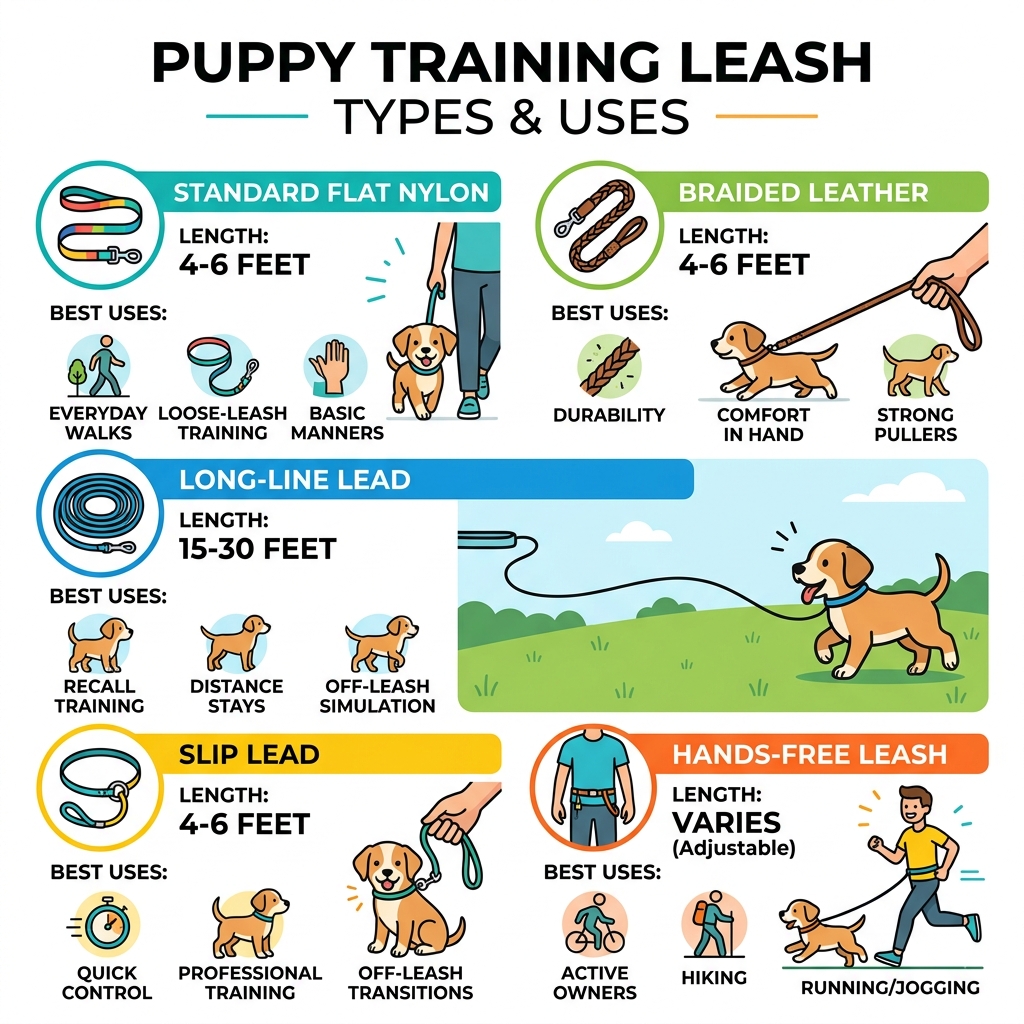
Understanding the Different Types of Puppy Training Leashes
When we talk about the best leash for puppy training, we aren’t just looking for a piece of rope with a clip. We are looking for a tool that helps us communicate. For most beginners, a standard flat leash made of nylon or leather is the gold standard. It’s predictable and durable.
However, as your puppy grows and you begin working on different skills, you might find that one leash isn’t enough. Many professional trainers recommend having a “wardrobe” of leashes for different environments. For example, a multi-function leash like a Vario 4™ offers adjustable lengths that can adapt to various training scenarios, while a specialized leash-training-for-small-dogs-a-comprehensive-guide can help you navigate the unique challenges of smaller breeds.
Here is a breakdown of the common types you’ll encounter:
- Standard Flat Leash: Usually 4 to 6 feet long. This is your “everyday” leash used for teaching your puppy to stay by your side.
- Long-Line Leads: These range from 15 to 50 feet (and sometimes up to 100 feet!). These are essential for teaching “come” (recall) and “stay” from a distance.
- Slip Leashes: These combine a collar and leash into one. They are popular with breeders and shelter workers because they are easy to put on, but they require a gentle hand to ensure the puppy doesn’t experience constant neck pressure.
- Martingale Styles: Often called “no-slip” leashes, these tighten slightly if the dog pulls but have a built-in “stop” to prevent choking. These are great for puppies with narrow heads who might back out of a regular collar.
To help you decide which is right for your current stage, consider this comparison:
| Feature | Short Leash (4-6 ft) | Long-Line Lead (15-50 ft) |
|---|---|---|
| Primary Use | Heeling, city walking, vet visits | Recall, distance stays, safe exploration |
| Control Level | High; keeps puppy close to your side | Low; requires more handler management |
| Safety | Best for high-traffic areas | Best for open parks or fields |
| Training Phase | Foundation skills (Sit, Down, Heel) | Advanced skills and off-leash preparation |
Why the Best Leash for Puppy Training Isn’t Retractable
You’ve seen them everywhere: the plastic handles with the thin cord that zips in and out. While they seem convenient, most professional trainers — and we at Portal Tambas — strongly advise against them for puppies.
First, retractable leashes actually encourage pulling. Your puppy learns that if they feel tension and keep walking, the leash extends. This is the exact opposite of what we want to teach during loose-leash walking.
Second, there are significant safety risks. The thin cords can cause “leash burns” on your legs or the puppy’s neck if they get tangled. Furthermore, the bulky plastic handles are easy to drop. If dropped, the handle “chases” the puppy as the cord retracts, which can terrify a young dog and cause them to bolt into traffic. For real control and communication, a fixed-length leash is always the best leash for puppy training.
The Role of Slip Leads and Martingales
Slip leads and martingales are often misunderstood. When used correctly, they are fantastic tools for behavior modification and control. A slip lead features a metal ring that allows the leash to tighten and loosen based on the dog’s movement. Expert trainers often use these for puppies transitioning to adulthood because they provide immediate feedback.
If you choose a slip lead, size matters. For example, the Mendota Slip Leash comes in a 3/8-inch diameter (perfect for puppies and small dogs) and a 1/2-inch diameter for larger breeds. The key is the “leather tab” adjustment. You should be able to fit two or three fingers between the loop and the dog’s neck. This ensures the leash won’t slip over the head but also won’t stay tight when the dog is behaving.
Martingale leashes are a bit more forgiving. They are often used for breeds like Greyhounds or Whippets, but they are also useful for any “Houdini” puppy that knows how to wiggle out of a standard flat collar.
Top-Rated Options for the Best Leash for Puppy Training
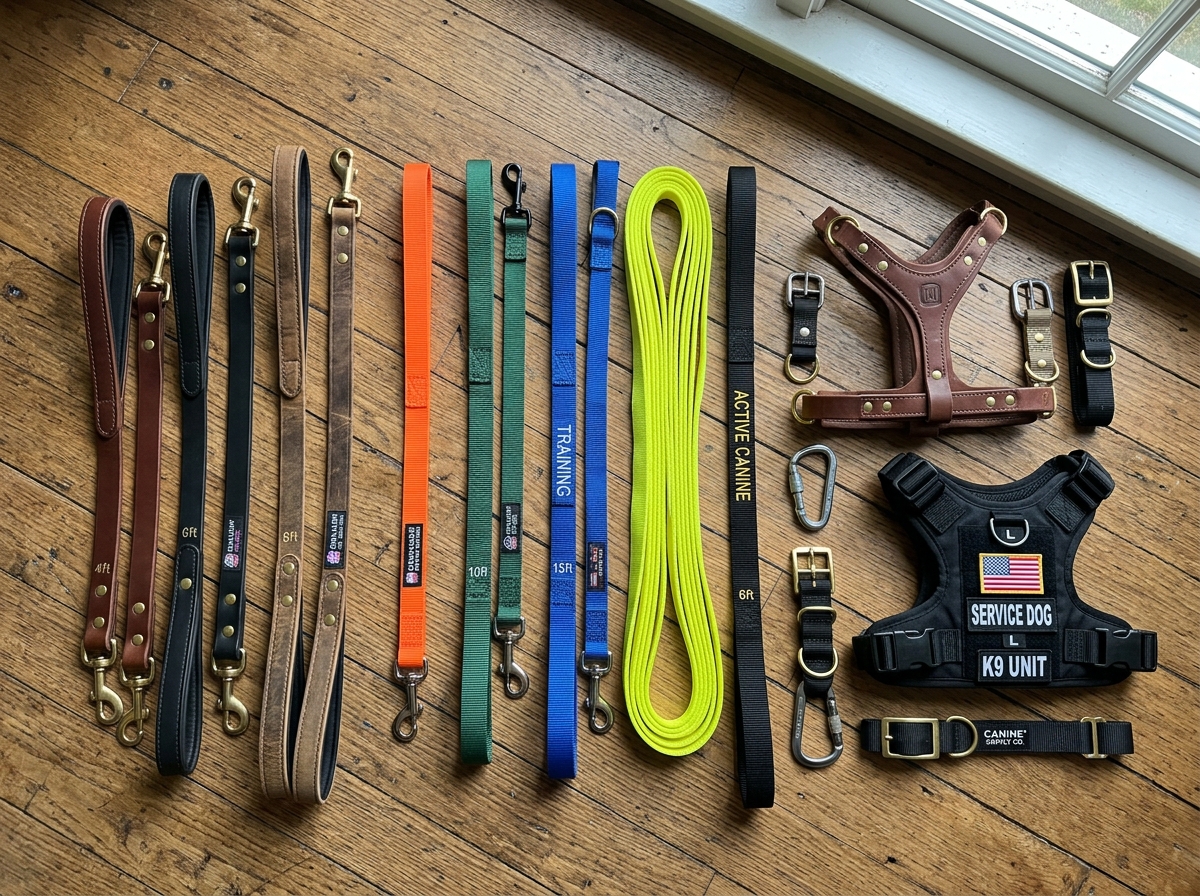
When shopping for the best leash for puppy training, looking at what other owners have tested can save you a lot of trial and error. Based on thousands of reviews and professional testing, a few standouts consistently rise to the top.
The Hi Kiss Dog Training Leash is a powerhouse in the long-line category, boasting more than 32,000 reviews on Amazon with a 4.5-star rating. It’s a favorite for teaching recall because it’s durable enough to withstand outdoor use and swimming.
For those who prefer the classic feel and strength of leather, the FAIRWIN Braided Leather Dog Leash is highly recommended. It has over 3,500 reviews and a 4.7-star rating. One of its most impressive stats? It can withstand 500 pounds of pulling force, making it a “buy it for life” item. Similarly, the Logical Leather Dog Leash is tested to withstand 245 pounds of force while weighing under 6 ounces — a great balance for a growing pup.
If you are an active owner, the iYoShop Hands-Free Dog Leash (4.7-star rating from 7,200+ reviews) allows you to train while hiking or running. This is particularly helpful for people with disabilities or those who need their hands free to deliver treats quickly.
Other reliable options include:
- PetSafe Premier Nylon Dog Leash: A classic, simple nylon lead with a 4.5-star rating on Chewy.
- Frisco Solid Nylon Dog Leash: An affordable, sturdy option for everyday walks.
- Mendota Slip Leash: A professional favorite for quick control and training.
Choosing the Best Leash for Puppy Training Based on Material
The material you choose affects everything from your grip comfort to the leash’s lifespan.
- Nylon: This is the most common material. It’s lightweight, affordable, and comes in every color imaginable. It’s weather-resistant and easy to clean (just soak it in hot water with some dog shampoo!). However, nylon can fray over time if your puppy likes to chew on their lead.
- Leather: Many trainers consider leather the best leash for puppy training because it’s easy on the hands. It softens over time and provides a natural “give” that nylon doesn’t. It does require more maintenance (conditioning) and can be more expensive.
- Biothane: This is a synthetic material that looks and feels like leather but is waterproof and odor-proof. It’s perfect for puppies who love mud and rain.
- Rope: Climbing-rope style leashes are incredibly strong and offer a bit of shock absorption. They are excellent for larger puppies who are enthusiastic pullers.
Specialized Leads for Distance and Recall
Once your puppy has mastered the basics of sitting and staying, it’s time to add “distance” to the equation. This is where the 30-foot lead becomes your best friend.
Using a long lead prevents unsuccessful training sessions. If you call your puppy and they decide to sniff a bush instead, you have the lead to gently guide them back to you. This prevents the “catch me if you can” game that many puppies love to play. Pupford offers a 30-foot long lead specifically designed for this purpose. They even have a version for small pups under 20 lbs, ensuring the hardware isn’t too heavy for a tiny frame.
Essential Features for Safety and Durability
A leash is a safety device first and a training tool second. When selecting the best leash for puppy training, look for these specific features:
- Padded Handles: Training involves a lot of “holding” and “waiting.” A neoprene or padded handle prevents the leash from cutting into your hand if your puppy lunges.
- Reflective Stitching: If you walk your puppy in the early morning or evening, reflective strips are a must for visibility against cars.
- Double-Handle (Traffic Handle) Designs: These leashes have a standard handle at the end and a second handle about one foot from the clip. This allows you to pull your puppy close in crowded areas or high-traffic situations. The 6 Foot Leash with Double Handle is a prime example of this design.
- Metal Clasp Quality: Look for heavy-duty brass or stainless steel clips. Avoid plastic clips, which can snap under pressure.
- Width Considerations: For a small puppy, a 0.5-inch or 5/8-inch width is ideal so the weight doesn’t pull on their neck. For larger breeds, a 1-inch width provides the necessary strength.
Harness vs Collar for Puppy Training
Should you clip that leash to a collar or a harness? For puppies, especially small breeds, the answer is often a harness.
Puppies have fragile necks and developing tracheas. If a puppy on a collar suddenly lunges at a squirrel, they can cause serious injury to their throat. A harness distributes that pressure evenly across the chest and shoulders.
- Front-Clip Harnesses: These are great for pullers. When the puppy pulls, the leash placement gently turns their body back toward you.
- Back-Clip Harnesses: Better for small dogs who don’t pull much, as it keeps the leash away from their feet.
Regardless of which you choose, always pair it with leveraging-positive-reinforcement-for-training-tiny-canines to ensure your puppy enjoys the training process.
Training Success: Matching the Leash to the Skill
The best leash for puppy training is only as good as the person holding it. To end the tug-of-war, you need to match the tool to the skill you are teaching.
- Loose-Leash Walking: Use a 4-6 foot standard leash. The goal is for the leash to always stay in a “J” shape. If the leash tightens, stop walking.
- Recall (Come): Use a 15-30 foot long lead. Start in a low-distraction environment (like your hallway) and gradually move outside.
- Heeling: Use a short leash or the “traffic handle” on a double-handle leash to keep your puppy’s shoulder aligned with your leg.
Training is hard work for a little brain! We recommend using high-value rewards. For example, a Training Starter Pack that includes a long lead and small, low-calorie treats can make sessions much more productive. In fact, some treat bags contain over 425 treats, which is a lot of “good boys” in one package!
For more on the basics, check out our guide on mastering-basic-commands-with-your-tiny-pup.
Maintenance and Longevity
To ensure your training leash lasts from puppyhood to adulthood, you need to take care of it.
- Nylon: Hand-wash with mild soap. Avoid the dryer, as high heat can weaken the fibers; air-drying is best.
- Leather: Wipe down with a damp cloth if it gets muddy. Use a leather conditioner once or twice a year to keep it from cracking.
- Hardware: Check the “spring” in the metal clasp regularly. If it starts to stick, a tiny drop of WD-40 or mineral oil can help.
- Inspection: Always check for frays or “chew marks.” A puppy can partially chew through a nylon leash in seconds, creating a weak point that might snap later.
Frequently Asked Questions about Puppy Training Leashes
At what age should I start leash training my puppy?
You can start as early as 8 to 10 weeks old! The first step isn’t even walking; it’s just letting the puppy wear a lightweight leash around the house (under supervision) so they get used to the feeling of something trailing behind them. Pair this with treats to build a positive association.
How do I choose the right leash size for my puppy’s breed?
It’s all about the weight and the width. A 1-inch wide leather leash might be too heavy for a 3-pound Yorkie puppy, causing them to tuck their tail and refuse to move. For “teacup” or small breeds, look for 3/8-inch or 1/2-inch widths with small, lightweight clips. For larger breeds like Labradors or Shepherds, you’ll want the 1-inch width for durability.
What are the most common mistakes when using a training leash?
The biggest mistake is wrapping the leash around your wrist. If your puppy lunges, this can cause serious injury to your hand or arm. Instead, put your thumb through the loop and fold the excess leash into your palm.
Another mistake is keeping constant tension on the leash. If you are always pulling back, your puppy will always pull forward (it’s a natural reflex called the opposition reflex). The best leash for puppy training should be loose whenever the puppy is doing the right thing.
Conclusion
Choosing the best leash for puppy training doesn’t have to be a headache. Whether you opt for a classic 6-foot nylon lead, a durable braided leather option, or a 30-foot long line for recall, the most important factor is consistency.
At Portal Tambas, we specialize in helping owners manage the big personalities of small dogs. Often, what looks like “aggression” or “stubbornness” on the leash is simply a lack of clear communication between the owner and the pup. By using the right tools and staying calm, you can turn your daily walks from a stressful tug-of-war into the highlight of your day.
For more expert advice on managing your small dog’s behavior, explore our category/training-tips. Happy training!